


Uesugi Kenshin: Difference between revisions
imported>Master Sima Yi mNo edit summary |
imported>Bovkaffe No edit summary |
||
| Line 7: | Line 7: | ||
When the army of fellow daimyo, [[Takeda Shingen]], neared Echigo, Kenshin moved to halt their advance. They fought to a stalemate, which was the start of a fierce rivalry between the two daimyos. A rivalry, which ended when Shingen was assassinated over the [[Sword of Eden]] in 1573. | When the army of fellow daimyo, [[Takeda Shingen]], neared Echigo, Kenshin moved to halt their advance. They fought to a stalemate, which was the start of a fierce rivalry between the two daimyos. A rivalry, which ended when Shingen was assassinated over the [[Sword of Eden]] in 1573. | ||
Kenshin joined the Templar Order after the arrival of the Europeans in Japan and was subsequently killed by the [[Assassins|Assassin]] [[Hattori Hanzō]] in 1578. | |||
==Gallery== | ==Gallery== | ||
Revision as of 19:11, 24 October 2014
- "Wars are to be won with swords and spears, not with rice and salt."
- ―Uesugi Kenshin.[src]

Uesugi Kenshin (18 February 1530 – 19 April 1578) was the head of the Uesugi clan and a member of the Templar Order. One of the most powerful daimyos of his time, Kenshin ruled Echigo province. In addition to his skill in battle, Kenshin was also a gifted administrator who greatly expanded industry and trade in his province.
When the army of fellow daimyo, Takeda Shingen, neared Echigo, Kenshin moved to halt their advance. They fought to a stalemate, which was the start of a fierce rivalry between the two daimyos. A rivalry, which ended when Shingen was assassinated over the Sword of Eden in 1573.
Kenshin joined the Templar Order after the arrival of the Europeans in Japan and was subsequently killed by the Assassin Hattori Hanzō in 1578.
Gallery
-
 Kenshin in full armor
 -
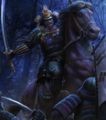 Kenshin on horseback

