

Storming of the Bastille: Difference between revisions
imported>Stormbeast mNo edit summary |
imported>MasterKenway No edit summary |
||
| Line 3: | Line 3: | ||
{{Spoilerhd}} | {{Spoilerhd}} | ||
{{Stub}} | {{Stub}} | ||
[[File:Fall of the Bastille - Concept Art.jpg|thumb|250px|Concept art of the storming of the Bastille]] | [[File:Fall of the Bastille - Concept Art.jpg|thumb|250px|Concept art of the storming of the Bastille]] | ||
The '''Storming of the Bastille''', which occurred on 14 July 1789, was an event in which angry [[Paris]]ian [[Civilians|citizens]] stormed and captured the infamous [[Bastille]] prison, a symbol of monarchist oppression in [[France]]. | The '''Storming of the Bastille''', which occurred on 14 July 1789, was an event in which angry [[Paris]]ian [[Civilians|citizens]] stormed and captured the infamous [[Bastille]] prison, a symbol of monarchist oppression in [[France]]. | ||
Although the prison was thought to be filled with political prisoners, only seven inmates were held at the time of the storming. Two of them were the [[French Assassins]] [[Pierre | Although the prison was thought to be filled with political prisoners, only seven inmates were held at the time of the storming. Two of them were the [[French Assassins]] [[Pierre Bellec ]]and [[Arno Dorian]]. After the two had met in May of that year, Bellec began training Arno in combat. When the facility was attacked by outraged Frenchmen two months later, the [[Assassins]] used the opportunity to make their escape. The novelist [[Donatien Alphonse François, Marquis de Sade|Donatien Alphonse François]] was also a prisoner, and was freed after the building fell to the attacking citizens. | ||
After the storming, the Bastille was used as a powerful propaganda symbol of might and willpower during the [[French Revolution]]. In the following months, and after much debate on what to do with the former prison, the [[Honoré Gabriel Riqueti, comte de Mirabeau|comte de Mirabeau]] settled the matter by destroying the first brick. By November, almost the entire [[Forts|fortress]] had been destroyed. The date of the storming, 14 July, was commemorated the following year as ''Le quatorze juillet'', or French National Day - known around the world as Bastille Day. | After the storming, the Bastille was used as a powerful propaganda symbol of might and willpower during the [[French Revolution]]. In the following months, and after much debate on what to do with the former prison, the [[Honoré Gabriel Riqueti, comte de Mirabeau|comte de Mirabeau]] settled the matter by destroying the first brick. By November, almost the entire [[Forts|fortress]] had been destroyed. The date of the storming, 14 July, was commemorated the following year as ''Le quatorze juillet'', or French National Day - known around the world as Bastille Day. | ||
| Line 20: | Line 19: | ||
==Trivia== | ==Trivia== | ||
*The storming of the Bastille was represented in ''[[Assassin's Creed: Unity]]'''s world premier trailer; however, in the trailer, Arno participates in the storming, instead of being trapped within the prison. | *The storming of the Bastille was represented in ''[[Assassin's Creed: Unity]]'''s world premier trailer; however, in the trailer, Arno participates in the storming, instead of being trapped within the prison. | ||
* Despite the fact that the prison was demolished by 1790, it remains, albeit heavily damaged, throughout the storyline of the game. | |||
==Reference== | ==Reference== | ||
* [[Assassin's Creed: Unity|''Assassin's Creed: Unity'']] | |||
[[Category:Timeline]] | [[Category:Timeline]] | ||
[[Category:French Revolution]] | [[Category:French Revolution]] | ||
Revision as of 04:36, 4 December 2014

|
He who increaseth knowledge, increaseth sorrow. This article contains spoilers, meaning it has information and facts concerning recent or upcoming releases from the Assassin's Creed series. If you do not want to know about these events, it is recommended to read on with caution, or not at all. |


The Storming of the Bastille, which occurred on 14 July 1789, was an event in which angry Parisian citizens stormed and captured the infamous Bastille prison, a symbol of monarchist oppression in France.
Although the prison was thought to be filled with political prisoners, only seven inmates were held at the time of the storming. Two of them were the French Assassins Pierre Bellec and Arno Dorian. After the two had met in May of that year, Bellec began training Arno in combat. When the facility was attacked by outraged Frenchmen two months later, the Assassins used the opportunity to make their escape. The novelist Donatien Alphonse François was also a prisoner, and was freed after the building fell to the attacking citizens.
After the storming, the Bastille was used as a powerful propaganda symbol of might and willpower during the French Revolution. In the following months, and after much debate on what to do with the former prison, the comte de Mirabeau settled the matter by destroying the first brick. By November, almost the entire fortress had been destroyed. The date of the storming, 14 July, was commemorated the following year as Le quatorze juillet, or French National Day - known around the world as Bastille Day.
Gallery
-
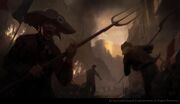 Revolutionaries about to storm the Bastille
 -
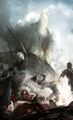 Civilians storming the fortress's walls
 -
 The storming, as seen from Notre-Dame's rooftops


Trivia
- The storming of the Bastille was represented in Assassin's Creed: Unity's world premier trailer; however, in the trailer, Arno participates in the storming, instead of being trapped within the prison.
- Despite the fact that the prison was demolished by 1790, it remains, albeit heavily damaged, throughout the storyline of the game.