

Seleucia-on-the-Tigris: Difference between revisions
imported>Batfan13 Created page with "{{Era|Locations}}{{WP-REAL|Seleucia}} {{Spoilerhd|5 January 2024|Assassin's Creed: Mirage}} thumb|250px|Seleucia-on-the-Tigris '''Seleucia-on-the-Tigris''', also known as '''Seleucia''' was an ancient Mesopotamian city. The ruins of the city was situated in southeastern part of the Wilderness, Baghdad in the 9th century. ==History== At the end of the 4th century BCE, Seleucia was founded by Seleucus I Nicato..." |
imported>Darman36 The "wilderness" is more a descriptor like "Frontier" in AC3 than a place name like Cairo, Egypt. |
||
| Line 2: | Line 2: | ||
{{Spoilerhd|5 January 2024|[[Assassin's Creed: Mirage]]}} | {{Spoilerhd|5 January 2024|[[Assassin's Creed: Mirage]]}} | ||
[[File:ACMir Seleucia on the Tigris 1.jpg|thumb|250px|Seleucia-on-the-Tigris]] | [[File:ACMir Seleucia on the Tigris 1.jpg|thumb|250px|Seleucia-on-the-Tigris]] | ||
'''Seleucia-on-the-Tigris''', also known as '''Seleucia''' was an ancient [[Mesopotamia]]n city. The ruins | '''Seleucia-on-the-Tigris''', also known as '''Seleucia''' was an ancient [[Mesopotamia]]n city. The city's ruins were situated in southeastern part of the [[wilderness]] that surrounded [[Baghdad]] in the 9th century. | ||
==History== | ==History== | ||
At the end of the 4th century BCE, Seleucia was founded by [[Seleucus I Nicator|Seleucos I]], one of the successors to [[Alexander the Great]]. Its position at the [[Tigris]] and near the [[Euphrates]] allowed the city to control movement of armies for nearly the next five centuries. While it became a commercial hub and royal residence, its influence suffered around 129 BCE when it was conquered by {{Wiki|Parthian Empire|Parthian Arsacids}}. Although its development progressed, the constant attacks by the [[Roman Empire| | At the end of the 4th century BCE, Seleucia was founded by [[Seleucus I Nicator|Seleucos I]], one of the successors to [[Alexander the Great]]. Its position at the [[Tigris]] and near the [[Euphrates]] allowed the city to control movement of armies for nearly the next five centuries. While it became a commercial hub and royal residence, its influence suffered around 129 BCE when it was conquered by {{Wiki|Parthian Empire|Parthian Arsacids}}. Although its development progressed, the constant attacks by the [[Roman Empire]]'s [[Roman army|armies]] and a disadvantageous shift in the Tigris riverbeds led to the decline and then disappearance of the city around the beginning of the 3rd century.<ref>''[[Assassin's Creed: Mirage]]'' – [[Database: Seleucia-on-the-Tigris]]</ref> Half a millennium later in the 860s, the [[Hidden Ones of Alamut|Alamut Hidden One]] [[Basim Ibn Ishaq]] recovered the book ''[[Kitab al-Azif]]'' while inspecting the ruins and brought it to the famed author [[Al-Jahiz]] at the [[House of Wisdom]] for his collection.<ref>''[[Assassin's Creed: Mirage]]'' – [[Al-Jahiz's Lost Books]]</ref> | ||
==Gallery== | ==Gallery== | ||
Revision as of 07:51, 26 November 2023

|
He who increaseth knowledge, increaseth sorrow. This article contains spoilers, meaning it has information and facts concerning Assassin's Creed: Mirage. If you do not want to know about these events, it is recommended to read on with caution, or not at all. |

Seleucia-on-the-Tigris, also known as Seleucia was an ancient Mesopotamian city. The city's ruins were situated in southeastern part of the wilderness that surrounded Baghdad in the 9th century.
History
At the end of the 4th century BCE, Seleucia was founded by Seleucos I, one of the successors to Alexander the Great. Its position at the Tigris and near the Euphrates allowed the city to control movement of armies for nearly the next five centuries. While it became a commercial hub and royal residence, its influence suffered around 129 BCE when it was conquered by Parthian Arsacids. Although its development progressed, the constant attacks by the Roman Empire's armies and a disadvantageous shift in the Tigris riverbeds led to the decline and then disappearance of the city around the beginning of the 3rd century.[1] Half a millennium later in the 860s, the Alamut Hidden One Basim Ibn Ishaq recovered the book Kitab al-Azif while inspecting the ruins and brought it to the famed author Al-Jahiz at the House of Wisdom for his collection.[2]
Gallery
-
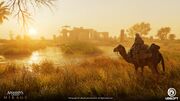 Basim arrives at the ruins of Seleucia-on-the-Tigris
