
Regan: Difference between revisions
imported>Lady Kyashira mNo edit summary |
imported>Lady Kyashira mNo edit summary |
||
| Line 17: | Line 17: | ||
==Behind the scenes== | ==Behind the scenes== | ||
The story of Lerion and his daughters is likely inspired by the {{Wiki|Leir of Britain|legendary figure}} of the same name, which was used by the playwright [[William Shakespeare]] as the basis for his play ''{{Wiki|King Lear}}''.<ref name="Leir of Britain">{{WP|Leir of Britain}}</ref> | The story of Lerion and his daughters is likely inspired by the {{Wiki|Leir of Britain|legendary figure}} of the same name, which was used by the playwright [[William Shakespeare]] as the basis for his play ''{{Wiki|King Lear}}''.<ref name="Leir of Britain">{{WP|Leir of Britain}}</ref> | ||
==Gallery== | ==Gallery== | ||
| Line 31: | Line 28: | ||
ACV Regan's Dagger.PNG|Regan's Dagger | ACV Regan's Dagger.PNG|Regan's Dagger | ||
</gallery> | </gallery> | ||
==Appearances== | |||
*''[[Assassin's Creed: Valhalla]]'' | |||
==References== | ==References== | ||
Revision as of 03:28, 25 February 2022

|
Patience, brothers. Soon we will reveal the secrets of this painting. This article has been identified as being out of date. Please update the article to reflect recent releases and then remove this template once done. |
Regan (died 870s) was the second daughter of Lerion, a wealthy East Anglian ealdorman who plotted to kill the Mercian king Burgred. The plot was foiled by King Edmund of East Anglia before it had hatched, leading to Lerion's arrest and execution for treason. Regan and her sisters, fearing they would suffer their father's fate or worse, fled into the fens of East Anglia and disappeared.[1]
During the 870s, the shieldmaiden Eivor Varinsdottir eventually fought and killed Regan while exploring England, claiming her dagger.[2]
Behind the scenes
The story of Lerion and his daughters is likely inspired by the legendary figure of the same name, which was used by the playwright William Shakespeare as the basis for his play King Lear.[3]
Gallery
-
 Concept art of Regan
 -
 Concept sketches of Regan
 -
 Database of Regan (middle) and her sisters
 -
 Regan confronting Eivor in the Walsham Crag
 -
 Regan fighting against Eivor
 -
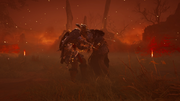 Regan's death
 -
 Regan's Dagger


Appearances
References
- ↑ Assassin's Creed: Valhalla – Database: The Daughters of Lerion
- ↑ Assassin's Creed: Valhalla
- ↑
 Leir of Britain on Wikipedia