


Pyramid of Cestius: Difference between revisions
imported>Uditore mNo edit summary |
imported>Smoke3723 Database transcript and references |
||
| Line 1: | Line 1: | ||
{{Era|ACB|PL}} | {{Era|ACB|PL}} | ||
{{WP-REAL}} | {{WP-REAL}} | ||
{{Landmarks Infobox|image = Piramide Cestia 1.png | |||
|description = The Roman adaptation of the Egyptian Pyramids. | |description = The Roman adaptation of the Egyptian Pyramids. | ||
||location = [[Antico District]], [[Rome]], [[Italy]] | ||location = [[Antico District]], [[Rome]], [[Italy]] | ||
| Line 10: | Line 10: | ||
|events = ||commissioner = Cauis Cestius}} | |events = ||commissioner = Cauis Cestius}} | ||
The '''Piramide Cestia''' (''English: Pyramid of Cestius'') is | The '''Piramide Cestia''' (''English: Pyramid of Cestius'') is a landmark in [[Rome]]. In the early 1500s it concealed an entrance to the [[Catacombe di Roma]].<ref name="brotherhood">''[[Assassin's Creed: Brotherhood]]''</ref> | ||
== | ==Database Entry== | ||
This giant tomb was built between 18 and 12 B.C.E. for Caius Cestius who was both a magistrate and a member of the Roman religious corporation known as Septemviri Epulonum, which was in charge of creating religious feasts for the gods, and distributing swag during parties. During the construction of the Aurelian Walls between 271 and 275, the pyramid was built into the bulwark, forming a triangular bastion in an effort to cut costs on the snowballing wall project. | |||
You'll notice the faces of the pyramid are far steeper than its Egyptian ancestors. This is attributed to erroneous sketches of the Egyptian pyramids which acted as the chief reference for its construction.<ref name="brotherhood"/> | |||
==Trivia== | ==Trivia== | ||
*The Pyramid can be bought as a Landmark by [[Ezio Auditore da Firenze|Ezio]], and it counts towards the rebuilding of Rome. | *The Pyramid can be bought as a Landmark by [[Ezio Auditore da Firenze|Ezio]], and it counts towards the rebuilding of Rome.<ref name="brotherhood"/> | ||
*The Pyramid can be bought as a territory in ''[[Assassin's Creed: Project Legacy]]''. | *The Pyramid can be bought as a territory in ''[[Assassin's Creed: Project Legacy]]''. | ||
{{ | |||
==References== | |||
{{reflist}} | |||
==Gallery== | ==Gallery== | ||
<gallery widths="280" position="center" captionalign="center" captiontextcolor="#ffffff" bordersize="medium"> | <gallery widths="280" position="center" captionalign="center" captiontextcolor="#ffffff" bordersize="medium"> | ||
| Line 28: | Line 32: | ||
[[Category:Landmarks]] | [[Category:Landmarks]] | ||
[[Category:Rome]] | [[Category:Rome]] | ||
Revision as of 06:06, 7 August 2011
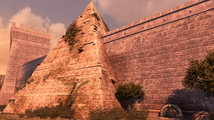
The Piramide Cestia (English: Pyramid of Cestius) is a landmark in Rome. In the early 1500s it concealed an entrance to the Catacombe di Roma.[1]
Database Entry
This giant tomb was built between 18 and 12 B.C.E. for Caius Cestius who was both a magistrate and a member of the Roman religious corporation known as Septemviri Epulonum, which was in charge of creating religious feasts for the gods, and distributing swag during parties. During the construction of the Aurelian Walls between 271 and 275, the pyramid was built into the bulwark, forming a triangular bastion in an effort to cut costs on the snowballing wall project.
You'll notice the faces of the pyramid are far steeper than its Egyptian ancestors. This is attributed to erroneous sketches of the Egyptian pyramids which acted as the chief reference for its construction.[1]
Trivia
- The Pyramid can be bought as a Landmark by Ezio, and it counts towards the rebuilding of Rome.[1]
- The Pyramid can be bought as a territory in Assassin's Creed: Project Legacy.
References
Gallery
-
 Entrance to Catacombe di Roma.

| |||||||||||||||||||||||||||||||||||||