

Ponte Sant'Angelo: Difference between revisions
imported>RebeccaAWB m Heading fix, replaced: ==Appearance== → ==Appearances==, ==Reference== → ==References== |
imported>UJ112013 No edit summary |
||
| Line 15: | Line 15: | ||
In 1450, its balustrades buckled due a surging mob of pilgrims making their way to the [[St. Peter's Basilica]], leading to a mass drowning. Later, in the 16th century, the structure was used to display the bodies of executed men to the public.<ref name="Database" /> | In 1450, its balustrades buckled due a surging mob of pilgrims making their way to the [[St. Peter's Basilica]], leading to a mass drowning. Later, in the 16th century, the structure was used to display the bodies of executed men to the public.<ref name="Database" /> | ||
Around 1506, working with the [[Italian Brotherhood of Assassins|Italian Assassins]], [[Sirus Favero]] tasked [[Lo Sparviero]], the assassin send by [[Niccolò Machiavelli]], to intercept one of the [[Crows|Crow]] messengers and take a very important letter from him. The messenger sooner appear on the Ponte Sant'Angelo. Lo Sparviero identify the messenger and killed him to retrieved the letter. Lo Sparviero handed the letter to Favero and saw his suspicious behavior. He followed him through the Ponte Sant'Angelo. Sooner he found out that Favero was the leader of the Crows, the man called "Il Corvo".<ref name="ACID">''[[Assassin's Creed: Identity]]''</ref> | |||
Later, Machiavelli learned the message, Favero was summoning all his Crows ready to attack the Brotherhood in Roma. He signal Lo Sparviero to help him to take down Il Corvo. The leader was opposite the Ponte Sant'Angelo. Lo Sparviero managed to cross under the bridge and avoid the most of the crows on the bridge. He eventually killed Il Corvo and his bodyguards. Leading to the surrender of most of the Crows, and return to meet Machiavelli.<ref name="ACID" /> | |||
==Trivia== | ==Trivia== | ||
| Line 29: | Line 33: | ||
==Appearances== | ==Appearances== | ||
*''[[Assassin's Creed: Brotherhood]]'' | *''[[Assassin's Creed: Brotherhood]]'' {{1st}} | ||
*''[[Assassin's Creed: Identity]]'' | |||
==References== | ==References== | ||
Revision as of 08:40, 2 March 2019
Ponte Sant'Angelo, or Bridge of the Holy Angel, is a landmark that connects the Vaticano district to the Centro district, and extends over the Tiber river in Rome.
History
The bridge was built to cross the river from the city center to Emperor Hadrian's mausoleum, which later became the Castel Sant'Angelo.[1]
In 1450, its balustrades buckled due a surging mob of pilgrims making their way to the St. Peter's Basilica, leading to a mass drowning. Later, in the 16th century, the structure was used to display the bodies of executed men to the public.[1]
Around 1506, working with the Italian Assassins, Sirus Favero tasked Lo Sparviero, the assassin send by Niccolò Machiavelli, to intercept one of the Crow messengers and take a very important letter from him. The messenger sooner appear on the Ponte Sant'Angelo. Lo Sparviero identify the messenger and killed him to retrieved the letter. Lo Sparviero handed the letter to Favero and saw his suspicious behavior. He followed him through the Ponte Sant'Angelo. Sooner he found out that Favero was the leader of the Crows, the man called "Il Corvo".[2]
Later, Machiavelli learned the message, Favero was summoning all his Crows ready to attack the Brotherhood in Roma. He signal Lo Sparviero to help him to take down Il Corvo. The leader was opposite the Ponte Sant'Angelo. Lo Sparviero managed to cross under the bridge and avoid the most of the crows on the bridge. He eventually killed Il Corvo and his bodyguards. Leading to the surrender of most of the Crows, and return to meet Machiavelli.[2]
Trivia
- The bridge was a restricted area in Brotherhood, except in certain memories, such as "The Ezio Auditore Affair".
- The bridge was formerly known as Pons Aelius or Ponte Aelius.
- Historically, the statues on the bridge were not placed until 1527 by order of Pope Clement VII.
Gallery
-
 The Ponte Sant'Angelo
 -
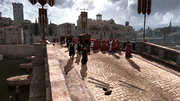 A crowd on the Ponte Sant'Angelo
 -
 The Ponte Sant'Angelo and Castel Sant'Angelo


Appearances
- Assassin's Creed: Brotherhood (first appearance)
- Assassin's Creed: Identity
References
| |||||||||||||||||||||||||||||||||||||