Welcome to Assassin's Creed Wiki! Log in and join the community.


Ponte Sant'Angelo: Difference between revisions
Jump to navigation
Jump to search
imported>Campbell430 No edit summary |
imported>Kaloneous m added subheading to tidy page |
||
| Line 6: | Line 6: | ||
In 1450, the bridge yielded due to the great crowds of the pilgrims, and many drowned in the river. In response, some houses at the head of the bridge as well as a Roman triumphal arch were pulled down in order to widen the route for pilgrims. During 16th century, the bridge was used to display the bodies of executed citizens to the public as a sign and warning. | In 1450, the bridge yielded due to the great crowds of the pilgrims, and many drowned in the river. In response, some houses at the head of the bridge as well as a Roman triumphal arch were pulled down in order to widen the route for pilgrims. During 16th century, the bridge was used to display the bodies of executed citizens to the public as a sign and warning. | ||
==Gallery== | |||
<gallery> | <gallery> | ||
Revision as of 11:10, 17 July 2011


Ponte Sant'Angelo, once the Aelian Bridge or Pons Aelius, meaning the Bridge of Hadrian, is a Roman bridge in Rome, central Italy, completed in 134 AD by Roman Emperor Hadrian, to span the Tiber, from the city center to his newly constructed mausoleum, now the towering Castel Sant'Angelo.
In 1450, the bridge yielded due to the great crowds of the pilgrims, and many drowned in the river. In response, some houses at the head of the bridge as well as a Roman triumphal arch were pulled down in order to widen the route for pilgrims. During 16th century, the bridge was used to display the bodies of executed citizens to the public as a sign and warning.
Gallery
-
 Ponte Sant'Angelo
 -
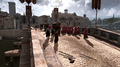 A crowd on the Ponte Sant'Angelo

