

Piracy: Difference between revisions
imported>Nanomat No edit summary |
imported>Sadelyrate No edit summary |
||
| Line 5: | Line 5: | ||
{{Quote|Many people these days consider many pirates to have been rather progressive socialists with community-minded consciences, which I rather feel takes away from their mystique.|[[Shaun Hastings]].|Assassin's Creed III}} | {{Quote|Many people these days consider many pirates to have been rather progressive socialists with community-minded consciences, which I rather feel takes away from their mystique.|[[Shaun Hastings]].|Assassin's Creed III}} | ||
[[File:Flag of Edward England.png|thumb|250px|The traditional "Jolly Roger" of piracy.]] | [[File:Flag of Edward England.png|thumb|250px|The traditional "Jolly Roger" of piracy.]] | ||
'''Piracy''' is a criminal act of robbery or violence, typically at sea, and can also range from naval warfare and coastal raids. Acts of piracy can be committed on land, in the air, or | '''Piracy''' is a criminal act of robbery or violence, typically at sea, and can also range from naval warfare and coastal raids. Acts of piracy can be committed on land, in the air, or near bodies of water including shores. | ||
An individual who participates in piracy is known as a '''pirate''', though they should not be confused with privateers | An individual who participates in piracy is known as a '''pirate''', though they should not be confused with privateers, who were state-sponsored sailors allowed to steal from the [[ships]] of enemy countries.{{Fact|March 2020}} | ||
In the early 18th century, a large number of pirates, privateers, and other sailors congregated in the recently captured settlement of [[Nassau]] and together formed the '''Brethren of the Coast''', in order to better represent and coordinate their interests. | In the early 18th century, a large number of pirates, privateers, and other sailors congregated in the recently captured settlement of [[Nassau]] and together formed the '''Brethren of the Coast''', in order to better represent and coordinate their interests.<ref name="AC4BF">''[[Assassin's Creed IV: Black Flag]]''</ref> | ||
==History== | ==History== | ||
===5th century BCE=== | ===5th century BCE=== | ||
Around the time of the [[Peloponnesian War]] pirates were a common sight on the [[Aegean Sea]]. The [[Sparta]]n [[Mercenary| | Around the time of the [[Peloponnesian War]] pirates were a common sight on the [[Aegean Sea]]. The [[Sparta]]n ''[[Mercenary|misthios]]'' [[Kassandra]] encountered them often aboard the ''[[Adrestia]]'', a [[trireme]] Kassandra commanded and whose captain [[Barnabas]] was.<ref>''[[Assassin's Creed: Odyssey]]''</ref> Occasionally, Kassandra took on a [[Bounty on a Pirate Ship|bounty]] for especially mighty pirate ships,<ref>''Assassin's Creed: Odyssey'' – [[Bounty on a Pirate Ship]]</ref> or agreed to help people by sinking various pirate vessels. | ||
===12th century=== | ===12th century=== | ||
Pirates sailed the [[Mediterranean Sea]] during the Middle Ages, including a group of Cypriot pirates who allied with the [[Templars]] controlling | Pirates sailed the [[Mediterranean Sea]] during the Middle Ages, including a group of [[Cyprus|Cypriot]] pirates who allied themselves with the [[Templars]] controlling Cyprus. During [[Altaïr Ibn-La'Ahad]]'s trip to Cyprus in 1191, a pirate named [[Pasha]] sailed him to [[Kyrenia]]. However, the majority of the pirates there attempted to capture him for the Templars. When Altaïr returned to [[Limassol]], he assassinated their [[Pirate Captain|captain]].<ref>''[[Assassin's Creed: Bloodlines]]''</ref> | ||
===14th century=== | ===14th century=== | ||
| Line 33: | Line 33: | ||
[[File:Prizes and Plunder 6.png|thumb|250px|Edward Kenway and Benjamin Hornigold plundering a Spanish ship]] | [[File:Prizes and Plunder 6.png|thumb|250px|Edward Kenway and Benjamin Hornigold plundering a Spanish ship]] | ||
[[Edward Kenway]] was a British privateer-turned-pirate active in the Caribbean, who joined the [[Assassins]] later into his life. In the pirate republic of Nassau, there were pirates such as [[Stede Bonnet]], [[Mary Read]], [[Edward Thatch]], [[Benjamin Hornigold]], [[John Cockram]], [[Josiah Burgess]], [[Charles Vane]], [[Jack Rackham]], [[Adéwalé]], [[Anne Bonny]], and [[Christopher Condent]], with many of them eventually banding together to form a coalition they referred to as "the Brethren of the Coast". By September 1715, almost five hundred men had joined the Brethren. However their capital, Nassau, fell to the British in 1718, quickly discouraging many members from staying. Most of the captains who had formed the group died over the years, leading to the Brethren's dissolution by 1722.<ref name=" | [[Edward Kenway]] was a British privateer-turned-pirate active in the Caribbean, who joined the [[Assassins]] later into his life. In the pirate republic of Nassau, there were pirates such as [[Stede Bonnet]], [[Mary Read]], [[Edward Thatch]], [[Benjamin Hornigold]], [[John Cockram]], [[Josiah Burgess]], [[Charles Vane]], [[Jack Rackham]], [[Adéwalé]], [[Anne Bonny]], and [[Christopher Condent]], with many of them eventually banding together to form a coalition they referred to as "the Brethren of the Coast". By September 1715, almost five hundred men had joined the Brethren. However their capital, Nassau, fell to the British in 1718, quickly discouraging many members from staying. Most of the captains who had formed the group died over the years, leading to the Brethren's dissolution by 1722.<ref name="AC4BF" /> | ||
Some pirates operated independently, such as [[Bartholomew Roberts]], [[Howell Davis]], [[Abel Bramah]], and [[Jing Lang]].<ref name=" | Some pirates operated independently, such as [[Bartholomew Roberts]], [[Howell Davis]], [[Abel Bramah]], and [[Jing Lang]].<ref name="AC4BF" /> | ||
During the mid 18th century, the pirates [[Joseph Reed]] and [[William Crest]] made a fortune attacking trade ships in the [[Atlantic Ocean]]. However, their [[Man O' War|Men O' War]], the ''[[Pilgrim]]'' and the ''[[Cauldron]]'', were eventually sunk by [[Shay Cormac]]'s ship, the ''[[Morrigan]]''.<ref>''[[Assassin's Creed: Rogue]]''</ref> | During the mid 18th century, the pirates [[Joseph Reed]] and [[William Crest]] made a fortune attacking trade ships in the [[Atlantic Ocean]]. However, their [[Man O' War|Men O' War]], the ''[[Pilgrim]]'' and the ''[[Cauldron]]'', were eventually sunk by [[Shay Cormac]]'s ship, the ''[[Morrigan]]''.<ref>''[[Assassin's Creed: Rogue]]''</ref> | ||
== | ==Behind the scenes== | ||
Though the emblem of the pirates in ''Assassin's Creed: Odyssey'' seems to be based on a 3rd century BC mosaic of a dragon from {{Wiki|Caulonia (ancient city)|Caulonia}},<ref>{{WP|Caulonia (ancient city)#Archaeology|Caulonia}}</ref> according to the ''[[Discovery Tour: Ancient Greece]]'', it's based on coins from {{Wiki|Halicarnassus|Halikarnassos}}.<ref>''Assassin's Creed: Odyssey'' – [[Discovery Tour: Ancient Greece#Megaris|Megaris: Bandit Banner]]</ref> | |||
==Gallery== | ==Gallery== | ||
Revision as of 10:42, 17 March 2020

|
Patience, brothers. Soon we will reveal the secrets of this painting. This article has been identified as being out of date. Please update the article to reflect recent releases and then remove this template once done. |

|
Ezio, my friend! How may I be of service? This article is in desperate need of a revamp. Please improve it in any way necessary in order for it to achieve a higher standard of quality in accordance with our Manual of Style. |
- "Many people these days consider many pirates to have been rather progressive socialists with community-minded consciences, which I rather feel takes away from their mystique."
- ―Shaun Hastings.[src]

Piracy is a criminal act of robbery or violence, typically at sea, and can also range from naval warfare and coastal raids. Acts of piracy can be committed on land, in the air, or near bodies of water including shores.
An individual who participates in piracy is known as a pirate, though they should not be confused with privateers, who were state-sponsored sailors allowed to steal from the ships of enemy countries. [citation needed]
In the early 18th century, a large number of pirates, privateers, and other sailors congregated in the recently captured settlement of Nassau and together formed the Brethren of the Coast, in order to better represent and coordinate their interests.[1]
History
5th century BCE
Around the time of the Peloponnesian War pirates were a common sight on the Aegean Sea. The Spartan misthios Kassandra encountered them often aboard the Adrestia, a trireme Kassandra commanded and whose captain Barnabas was.[2] Occasionally, Kassandra took on a bounty for especially mighty pirate ships,[3] or agreed to help people by sinking various pirate vessels.
12th century
Pirates sailed the Mediterranean Sea during the Middle Ages, including a group of Cypriot pirates who allied themselves with the Templars controlling Cyprus. During Altaïr Ibn-La'Ahad's trip to Cyprus in 1191, a pirate named Pasha sailed him to Kyrenia. However, the majority of the pirates there attempted to capture him for the Templars. When Altaïr returned to Limassol, he assassinated their captain.[4]
14th century
In 1321, the Templars in Italy hired pirates to steal Altaïr Ibn-La'Ahad's Codex from Domenico Auditore, murdering his wife in the process.[5]
16th century
In 1511, Al-Scarab was an honorable pirate who sought revenge on Ezio Auditore da Firenze for humiliating him, but after they worked together to fight off some watchmen, he returned the favor by sailing him to Acre.[6] Soon after, the Ottoman Assassins allied with the corsair Hayreddin Barbarossa to undermine Spanish control of Algiers. Also active at the time was the Templar pirate Eveline Guerra, and Blaise Legros, whose only loyalty was to money, transporting Templars and Assassins wherever they desired so long as they could pay him.[7]
17th century
The Golden Age of Piracy was considered to have taken place from the late 17th century to the early 18th century in the Caribbean Sea. The French pirate François l'Olonnais was active in the Caribbean Sea during the late 17th century. He was infamous for his cruelty, torturing his prisoners.[8]
During this time, William Kidd was a Scottish privateer active in the area. He was captured and executed on charges of piracy in 1701, but in truth, the accusations were made by Templars, hoping he would reveal the location of the Shard of Eden he had found.[9]
18th century
Alonzo Batilla and Olivier Levasseur were French privateers-turned-pirates operating in the Caribbean during the early 18th century. Levasseur, better known as La Buse, would later be executed by the British.[8]

Edward Kenway was a British privateer-turned-pirate active in the Caribbean, who joined the Assassins later into his life. In the pirate republic of Nassau, there were pirates such as Stede Bonnet, Mary Read, Edward Thatch, Benjamin Hornigold, John Cockram, Josiah Burgess, Charles Vane, Jack Rackham, Adéwalé, Anne Bonny, and Christopher Condent, with many of them eventually banding together to form a coalition they referred to as "the Brethren of the Coast". By September 1715, almost five hundred men had joined the Brethren. However their capital, Nassau, fell to the British in 1718, quickly discouraging many members from staying. Most of the captains who had formed the group died over the years, leading to the Brethren's dissolution by 1722.[1]
Some pirates operated independently, such as Bartholomew Roberts, Howell Davis, Abel Bramah, and Jing Lang.[1]
During the mid 18th century, the pirates Joseph Reed and William Crest made a fortune attacking trade ships in the Atlantic Ocean. However, their Men O' War, the Pilgrim and the Cauldron, were eventually sunk by Shay Cormac's ship, the Morrigan.[10]
Behind the scenes
Though the emblem of the pirates in Assassin's Creed: Odyssey seems to be based on a 3rd century BC mosaic of a dragon from Caulonia,[11] according to the Discovery Tour: Ancient Greece, it's based on coins from Halikarnassos.[12]
Gallery
-
 Concept art of a pirate ship on fire near a canoe
 -
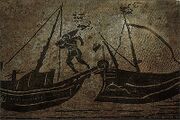 A mosaic of Cilician pirates
 -
The Treaty of Utrecht
-
The Pirate code of Bartholomew Roberts
-
One of the letters of marque supporting privateering
-
 Hornigold speaking with a captive crewman
 -
 Edward Kenway with a captured crew
 -
 A pirate pentaconter in 5th century BCE
 -
 A pirate bireme in 5th century BCE
 -
 A pirate heavy trireme in 5th century BCE
 -
The emblem of the pirates during the Peloponnesian War


Appearances
- Assassin's Creed: Bloodlines (first appearance)
- Assassin's Creed II (mentioned only)
- Assassin's Creed: Revelations
- Assassin's Creed: Revelations novel
- Assassin's Creed IV: Black Flag
- Assassin's Creed: Black Flag
- Assassin's Creed: Pirates
- Assassin's Creed: Rogue
- Assassin's Creed: Reflections
- Assassin's Creed: Odyssey
References
- ↑ 1.0 1.1 1.2 Assassin's Creed IV: Black Flag
- ↑ Assassin's Creed: Odyssey
- ↑ Assassin's Creed: Odyssey – Bounty on a Pirate Ship
- ↑ Assassin's Creed: Bloodlines
- ↑ Assassin's Creed II - Auditore Family Crypt
- ↑ Assassin's Creed: Revelations novel
- ↑ Assassin's Creed: Revelations
- ↑ 8.0 8.1 Assassin's Creed: Pirates
- ↑ Assassin's Creed III
- ↑ Assassin's Creed: Rogue
- ↑
 Caulonia on Wikipedia
- ↑ Assassin's Creed: Odyssey – Megaris: Bandit Banner