Welcome to Assassin's Creed Wiki! Log in and join the community.


Khamerernebty II: Difference between revisions
Jump to navigation
Jump to search
imported>Bovkaffe No edit summary |
imported>Lady Kyashira No edit summary |
||
| Line 6: | Line 6: | ||
Khamerernebty was born to the pharaoh [[Khafre]] and married her brother [[Menkaure]], who became the next pharaoh. She was also a priestess of {{Wiki|Thoth}} and Tjasepef, and was buried in the [[Pyramid of Menkaure]]. | Khamerernebty was born to the pharaoh [[Khafre]] and married her brother [[Menkaure]], who became the next pharaoh. She was also a priestess of {{Wiki|Thoth}} and Tjasepef, and was buried in the [[Pyramid of Menkaure]]. | ||
The [[Medjay]], [[Bayek]], explored the pyramid in 48 BCE, where he discovered Khamerernebty II's sarcophagus in a chamber along with an {{Wiki|Old Kingdom of Egypt|Old Kingdom}} stele. | |||
<gallery position="center" captionalign="center" widths="250"> | |||
ACO Khamerernebty II Sarcophagus.jpg|Khamerernebty II's sarcophagus in the Pyramid of Menkaure | |||
</gallery> | |||
==Reference== | ==Reference== | ||
*''[[Assassin's Creed: Origins]]'' | *''[[Assassin's Creed: Origins]]'' | ||
Revision as of 02:57, 18 January 2018
- "Her most serene ethereal goddess, Khamerernebty II. Mother of the King of Upper and Lower Egypt. She who sees Horus and Seth. Great one of the hetes-scepter. One great of praise, Priestess of Djehuty, Priestess of Tjasepef, the Greatly loved wife of the King, King's Daughter of his body, revered mistress, honored by the Great God."
- ―Inscription in the tomb of Khamerernebty.[src]
Khamerernebty III was a queen of the fourth Dynasty of Egypt.
Khamerernebty was born to the pharaoh Khafre and married her brother Menkaure, who became the next pharaoh. She was also a priestess of Thoth and Tjasepef, and was buried in the Pyramid of Menkaure.
The Medjay, Bayek, explored the pyramid in 48 BCE, where he discovered Khamerernebty II's sarcophagus in a chamber along with an Old Kingdom stele.
-
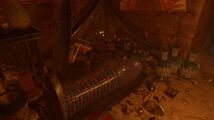 Khamerernebty II's sarcophagus in the Pyramid of Menkaure
