
Harbor of Theodosius: Difference between revisions
imported>Andre982d Database entry |
imported>Nostalgia AC m Infobox and spacing. |
||
| Line 2: | Line 2: | ||
{{Stub}} | {{Stub}} | ||
{{Landmarks Infobox | {{Landmarks Infobox | ||
|name = | |name = Harbor of Theodosius | ||
|image = Arsenal Harbor of Theodosius Database image.png | |image = Arsenal Harbor of Theodosius Database image.png | ||
|description = | |description = | ||
| Line 9: | Line 9: | ||
|functions= | |functions= | ||
|appearance = ''[[Assassin's Creed Revelations]]''}} | |appearance = ''[[Assassin's Creed Revelations]]''}} | ||
The '''Harbor of Theodosius''' was one of the ports of ancient [[Constantinople]], the capital of the [[Byzantines|Byzantine Empire]]. The harbor was located on the south side of the peninsula where the city is built, facing towards the Sea of Marmara. | The '''Harbor of Theodosius''' was one of the ports of ancient [[Constantinople]], the capital of the [[Byzantines|Byzantine Empire]]. The harbor was located on the south side of the peninsula where the city is built, facing towards the Sea of Marmara. | ||
Revision as of 05:09, 17 December 2011

The Harbor of Theodosius was one of the ports of ancient Constantinople, the capital of the Byzantine Empire. The harbor was located on the south side of the peninsula where the city is built, facing towards the Sea of Marmara.
History
In 1511, rioters, led by Ezio Auditore da Firenze, infiltrated the harbor and broke through the gates after becoming fed up with the Janissaries. The rioters engaged in a small skirmish with the Janissaries, while Ezio pursued a member of the Templar Order, Manuel Palaiologos.
Ezio tailed Manuel and his fellow Templar Shahkulu to a small area where they were storing weapons. After observing a brief meeting between Shahkulu, Manuel and Tarik Barleti, Ezio fled the harbor in an attempt to alert his fellow Assassins. Upon arriving back at the Arsenal gates, Ezio found the rioters slaughtered, and left the harbor.
Database entry
Originally called the Harbor of Elutherios by the city’s original Greek inhabitants, this was largest of Constantinople’s numerous ports. Augmented by Emperor Theodosius in the fourth century it became a major port for the trading of agricultural goods, and later a military outpost.
Not long after the Ottomans took over, the port was noted to have succumbed to a heavy amount of silting and it was eventually closed off and built over. By the seventeenth century it had all but disappeared. In the 21st century, workers excavating the site in preparation for a project discovered the remains of dozens of ancient Byzantine galleys sunk deep into the soil.
Gallery
-
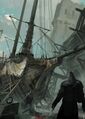 Concept art of the harbor.
 -
 Concept art of the harbor.
 -
 Concept art of the harbor.


