Welcome to Assassin's Creed Wiki! Log in and join the community.


Greek fire: Difference between revisions
Jump to navigation
Jump to search
imported>Greek assassin |
imported>Slate Vesper m Undo revision 296628 by Greek assassin (talk) |
||
| Line 25: | Line 25: | ||
Greek Fire Firing Nozel Concept.JPG|Concept art of the Greek Fire mechanism by [[Martin Deschambault]]. | Greek Fire Firing Nozel Concept.JPG|Concept art of the Greek Fire mechanism by [[Martin Deschambault]]. | ||
Assassin's Creed Revelations (4).jpg|Ezio ordered his Assassin to burn the Templars with Greek Fire | Assassin's Creed Revelations (4).jpg|Ezio ordered his Assassin to burn the Templars with Greek Fire | ||
</gallery> | </gallery> | ||
Revision as of 00:12, 21 April 2012

Greek Fire, (Greek: Υγρό Πυρ, meaning "liquid fire") was an incendiary weapon available in Constantinople.[1]
History
First used by Byzantine Emperor Leon III's army when enemy vessels laid siege to Constantinople in 717 AD, Greek Fire burned through the enemy fleet, forcing them to lift their attack and travel west.[2]
In 1511, the Assassin Ezio Auditore da Firenze used the flammable substance in order to destroy several ships in the port that prevented him from leaving the city.[1]
Greek Fire was a closely guarded military secret. Its composition remains unknown, despite multiple theories.[2]
Trivia
- Greek Fire was first seen in the E3 Gameplay Demo of Assassin's Creed: Revelations. Its concept appears similar to the Naval Cannon featured in Assassin's Creed: Brotherhood.
- Greek Fire can be put in Assassin Dens on barricades in order to counter a Byzantine Templar attack on a den.[1]
Gallery
-
Ezio preparing to use Greek Fire.
-
Greek Fire in use.
-
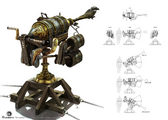 Concept art.
 -
Ezio using Greek Fire in Assassin's Creed: Revelations (mobile game).
-
 Concept art of the Greek Fire mechanism by Martin Deschambault.
 -
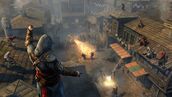 Ezio ordered his Assassin to burn the Templars with Greek Fire


.jpg)


