

Acquedotto Claudio: Difference between revisions
imported>Freddy Rodriguez |
imported>DunBanner clarity, removed unnecessary text |
||
| Line 2: | Line 2: | ||
{{WP-REAL|Aqua Claudia}} | {{WP-REAL|Aqua Claudia}} | ||
[[File:Acquedotto_Claudia_1.png|thumb|270px|right|Acquedotto Claudia.]] | [[File:Acquedotto_Claudia_1.png|thumb|270px|right|Acquedotto Claudia.]] | ||
The '''Acquedotto Claudia''' | The '''Acquedotto Claudia''' was a major [[Aqueducts|aqueduct]] located in the [[Italy|Italian]] city of [[Rome]]. | ||
==Construction== | ==Construction== | ||
Construction of the Aqueduct was started under the Roman Emperor [[Caligula]] in 38 AD. He was assassinated however, by [[Leonius]] with a knife on January 24, 41 AD, before he could see his project to fruition. The aqueduct was later completed in 52 AD under Emperor Claudius. | Construction of the Aqueduct was started under the Roman Emperor [[Caligula]] in 38 AD. He was assassinated however, by [[Leonius]] with a knife on January 24, 41 AD, before he could see his project to fruition. The aqueduct was later completed in 52 AD under Emperor Claudius. | ||
==Restoration== | ==Restoration== | ||
The aqueduct went between being functional to being unused throughout the years that followed. It was restored by Emperor [[wikipedia:Vespasian|Vespasian]] in 71 AD and Emperor Titus in 81 AD. By the time the [[Assassins|Assassin]] [[Ezio Auditore da Firenze|Ezio Auditore]] arrived in Rome in January of 1500, it had fallen to disrepair and became nothing more than several ruined structures located in the countryside. As part of the [[Liberation of Rome]], Ezio restored this magnificent structure, bringing water back to key areas in the city as a result. | |||
The aqueduct went between being functional to being unused throughout the years that followed. It was restored by Emperor [[wikipedia:Vespasian|Vespasian]] in 71 AD and Emperor Titus in 81 AD. By the time [[Ezio Auditore da Firenze|Ezio Auditore]] arrived in Rome in January of 1500, it had fallen to disrepair and became nothing more than several ruined structures in the countryside. As part of the [[Liberation of Rome]], Ezio restored this magnificent structure, bringing water back to key areas in the city as a result. | |||
==Database Entry== | ==Database Entry== | ||
''One of the Ancient aqueducts that supplied the city, at its peak the Acquedotto Claudia was able to provide all 14 districts with water. The hugely relied upon source inexplicably went dry for 9 years right around the time Nero was building his modest [[Nero's Golden Palace|Golden Palace]]. His little pet project required vast amounts of water but, luckily, the main build site was at the foot of Claudia's castellum (or storage reservoir). To this day historians are baffled as to what caused the drought. My bet: dramatic tension.'' | ''One of the Ancient aqueducts that supplied the city, at its peak the Acquedotto Claudia was able to provide all 14 districts with water. The hugely relied upon source inexplicably went dry for 9 years right around the time Nero was building his modest [[Nero's Golden Palace|Golden Palace]]. His little pet project required vast amounts of water but, luckily, the main build site was at the foot of Claudia's castellum (or storage reservoir). To this day historians are baffled as to what caused the drought. My bet: dramatic tension.'' | ||
==Trivia== | ==Trivia== | ||
* | *At several sections along the broken aqueduct, [[architects]] can be found, for which Ezio can pay to renovate that section. Once parts of the aqueduct have been rebuilt, the structure will generate increased income; collected from a [[bank]]. The Acquedotto Claudia is made from four of the eight broken aqueducts in Rome and these four constructions are located in the [[Antico district]]. | ||
*The Acquedotto Claudia is the location of one of [[Subject 16]]'s [[rifts]]. | |||
==Gallery== | ==Gallery== | ||
Revision as of 15:22, 19 September 2011

The Acquedotto Claudia was a major aqueduct located in the Italian city of Rome.
Construction
Construction of the Aqueduct was started under the Roman Emperor Caligula in 38 AD. He was assassinated however, by Leonius with a knife on January 24, 41 AD, before he could see his project to fruition. The aqueduct was later completed in 52 AD under Emperor Claudius.
Restoration
The aqueduct went between being functional to being unused throughout the years that followed. It was restored by Emperor Vespasian in 71 AD and Emperor Titus in 81 AD. By the time the Assassin Ezio Auditore arrived in Rome in January of 1500, it had fallen to disrepair and became nothing more than several ruined structures located in the countryside. As part of the Liberation of Rome, Ezio restored this magnificent structure, bringing water back to key areas in the city as a result.
Database Entry
One of the Ancient aqueducts that supplied the city, at its peak the Acquedotto Claudia was able to provide all 14 districts with water. The hugely relied upon source inexplicably went dry for 9 years right around the time Nero was building his modest Golden Palace. His little pet project required vast amounts of water but, luckily, the main build site was at the foot of Claudia's castellum (or storage reservoir). To this day historians are baffled as to what caused the drought. My bet: dramatic tension.
Trivia
- At several sections along the broken aqueduct, architects can be found, for which Ezio can pay to renovate that section. Once parts of the aqueduct have been rebuilt, the structure will generate increased income; collected from a bank. The Acquedotto Claudia is made from four of the eight broken aqueducts in Rome and these four constructions are located in the Antico district.
- The Acquedotto Claudia is the location of one of Subject 16's rifts.
Gallery
-
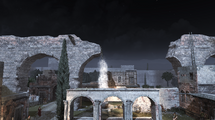 The broken aqueduct.
 -
Ezio runs along Acquedotto Claudia.


Source
| |||||||||||||||||||||||||||||||||||||