

Bottega di Leonardo: Difference between revisions
imported>GuardDog adjusting images, removing lower quality ones |
imported>Vatsa1708 mNo edit summary |
||
| Line 1: | Line 1: | ||
{{Era|AC2|ACB}} | {{Era|AC2|ACB}} | ||
{{WPlocations}} | {{WPlocations}} | ||
[[File:ACB- | [[File:ACB-DVD-SPTrailer Workshop.png|thumb|300px|right|Leonardo in his workshop in Rome.]] | ||
'''Bottega di Leonardo''' was the workshop of the famed polymath [[Leonardo da Vinci]], where he would often design and build his inventions, as well as decode pages of the [[Codex]]. | '''Bottega di Leonardo''' was the workshop of the famed polymath [[Leonardo da Vinci]], where he would often design and build his inventions, as well as decode pages of the [[Codex]]. | ||
Revision as of 12:11, 19 June 2012
Bottega di Leonardo was the workshop of the famed polymath Leonardo da Vinci, where he would often design and build his inventions, as well as decode pages of the Codex.
Throughout the years, he relocated his operations from Florence, to Venice, then Rome; however, the workshop would maintain its appearance and purpose.
Florence

Shortly after completing his apprenticeship under Verrocchio, Leonardo established his own workshop in the center of Florence. There, he created commissions for the local townspeople, one of whom was Maria Auditore da Firenze. Through her, Leonardo became acquainted with her son, Ezio, who would frequent his different workshops in later years.[1]
After Ezio's family was executed in 1476, Leonardo once hid him in his workshop, while he in turn went to intercept the guard searching for him.[1]
Aside from painting and design, Leonardo also studied human anatomy. He stored and dissected bodies in his workshop, which the city often sent him for research. Because of this, Ezio was once able to hide a guard he had killed in Leonardo's workshop.[1]

This studio was where Leonardo first received and decoded a page of Altaïr Ibn-La'Ahad's Codex, with which he repaired the Hidden Blade. Through other pages, he also constructed upgrades for it, including the second blade, and poison blade.[1]
Leonardo also allowed Ezio to practice with his hidden blade in the courtyard next to the workshop; instructing his assistant at the time, Vincenzo, to set up dummies for him to use.[1]
After receiving a commission from a Venetian noble in 1480, Leonardo left Florence, and relocated his workshop to Venice.[1]
Venice
- "And now, I present to you, your workshop, Ser da Vinci! We spared no expense in its design! You'll see it is perfect; as if you never left Firenze!"
- ―Alvise da Vilandino.[src]
Upon his arrival and subsequent tour of the city by Alvise da Vilandino, Leonardo was introduced to his new workshop. Alvise commented that it would be "as if he never left Firenze," and indeed, the building and interior were nearly identical to his workshop in Florence.[1]

Leonardo continued to decode Codex pages for Ezio in this workshop, and built the Hidden Gun upgrade of the hidden blade. Here, he also improved the design of his Flying Machine, which allowed Ezio to fly over Venice to the Palazzo Ducale.[1]
During 1488, after retrieving the Apple of Eden from Rodrigo Borgia, Ezio took it to Leonardo's workshop. There, he, Leonardo, Mario Auditore, and Niccolò Machiavelli attempted to discover its purpose.[1]
Despite departing from Venice years later, it was rumored that Leonardo used his workshop there as a secret retreat, returning to it repeatedly during his life.[1]
Rome
In 1499, after being forcibly recruited by the Papal Captain General Cesare Borgia, Leonardo began to design and create weapons and war machines for the Borgia forces. As such, by 1500, he had relocated his workshop to Rome.[2]
He remained there even after Cesare's fall from power.[2] In 1506, Leonardo spent much time in his workshop studying Pythagoras, and the Pythagorean temple, as well as working on his latest painting, the Mona Lisa.[3]
During that same year, Leonardo was kidnapped from his workshop by Hermeticists, who also ransacked the building's room in search of his map to the temple of Pythagoras. He managed to leave a clue for Ezio to find him by writing on the floor of the workshop.[3]
During their attempts to find the artist, Ezio and Leonardo's assistant Salaì used his workshop to store the da Vinci paintings they recovered, as well as search them for clues.[3]
Trivia
- The memory "Ace Up My Sleeve" in Assassin's Creed II is the first time that Ezio enters the workshop.
- In Assassin's Creed: Brotherhood, you are able to enter the workshop during the Cristina Memories that take place in Florence.
Gallery
-
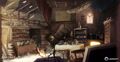 Concept art of Leonardo's workshop.
 -
 Concept art of Leonardo's workshop.
 -
Leonardo looking over his designs.
-
Some of Leonardo's sketches in his workshop.
-
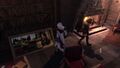 Ezio and Salaì in Leonardo's workshop.


