


Bayonet: Difference between revisions
No edit summary |
imported>AgentG231 Undo revision 522461 by 137.186.72.243 (talk)LOL, yes but no.... |
||
| Line 11: | Line 11: | ||
==Trivia== | ==Trivia== | ||
*Historically, bayonets were | *Historically, bayonets were removed outside of melee combat. | ||
==Gallery== | ==Gallery== | ||
Revision as of 02:24, 24 November 2013

Bayonets were weapon attachments that could be fit onto the muzzle of muskets and rifles, often as sharp spikes or knives.
During the Louisiana Rebellion and American Revolutionary War, bayonets were utilized by soldiers from the French, Spanish, British and Continental armies, though generally as last-resort ancillary weapons.
In most cases, bayonets were attached in preparation to receive a cavalry charge, as the crude spear they formed was effective at staking horsemen, before they reached the otherwise vulnerable infantry. They were also utilized in close-quarters combat, when shooting would have been insufficient.
The Assassins Aveline de Grandpré and Ratonhnhaké:ton were able to disarm soldiers for their muskets, while the latter could also grab them from nearby racks, in order to slash or impale nearby enemies. While a bayonet was embedded in a soldier's torso, Ratonhnhaké:ton could also aim and fire the musket itself, efficiently eliminating two opponents in quick succession.
Trivia
- Historically, bayonets were removed outside of melee combat.
Gallery
-
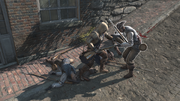 Connor impaling a Continental soldier with a bayonet
 -
 Connor facing a group of soldiers armed with bayonets

