
Palazzo Auditore: Difference between revisions
imported>Kaloneous |
imported>Soranin |
||
| (37 intermediate revisions by 22 users not shown) | |||
| Line 1: | Line 1: | ||
{{Era| | {{Era|Landmarks}} | ||
{{Landmarks Infobox | {{Landmarks Infobox | ||
|image = | |image = Palazzo Auditore 1 v.png | ||
|description = The residence of the Auditore family. | |description = The residence of the Auditore family. | ||
|location = [[San Giovanni District]], [[Florence]], [[Italy]] | |location = [[San Giovanni District]], [[Florence]], [[Italy]] | ||
|dateconstructed = 1473 | |dateconstructed = 1473 | ||
|functions = Private residence<br>[[Assassins|Assassin]] safehouse | |functions = Private residence<br />[[Assassins|Assassin]] safehouse | ||
|features = | |features = | ||
|events = | |events = | ||
}} | |||
The '''Palazzo Auditore''' (English: ''Auditore Palace'') was the home of the [[House of Auditore|Auditore]] family within the city of [[Florence]], [[Italy]]. The building was easily recognizable by the flags bearing the Auditore family emblem. | |||
The '''Palazzo Auditore''' (English: ''Auditore Palace'') was the home of the | |||
==History== | ==History== | ||
===Construction and conception=== | ===Construction and conception=== | ||
Initial sketches for the palazzo were completed by [[ | Initial sketches for the palazzo were completed by [[Leon Battista Alberti]], but the actual plans were completed by the building's commissioner and owner, [[Giovanni Auditore da Firenze]].<ref>''[[Assassin's Creed II]]'' – [[Database: Palazzo Auditore]]</ref> These included secret passages and rooms where Giovanni could perform his [[Assassins|Assassin]] duties.<ref name="AC2">''Assassin's Creed II''</ref><ref name="Lineage">''[[Assassin's Creed: Lineage]]''</ref> | ||
===Auditore execution=== | ===Auditore execution=== | ||
The building was completed in 1473, but in 1476, the Auditore family was executed and the building was abandoned, apart from a contingent of Florentine city [[guards]] stationed along the palazzo's roof.<ref name=" | The building was completed in 1473, but in 1476, the Auditore family was executed and the building was abandoned, apart from a contingent of Florentine city [[guards]] stationed along the palazzo's roof, presumably remaining on the lookout for the lone surviving Auditore, [[Ezio Auditore da Firenze|Ezio]]. These guards were removed upon the failure of the [[Pazzi conspiracy]], leaving the palazzo completely abandoned.<ref name="AC2" /> | ||
The palazzo was once again briefly occupied in 1494, when [[France|French]] troops invaded Florence and ousted [[Piero de' Medici]]. The occupying French troops used the palazzo as a billet, until departing to conquer the Kingdom of [[Naples|Naples.]] The palazzo was stripped of its remaining contents during the [[Bonfire of the Vanities]]. It was at this time that Ezio revisited the palazzo, where he experienced a [[Easter eggs#Ghosts of the Past|ghostly vision]] of his family.<ref name="AC2 - Bonfire">''Assassin's Creed II'' – ''[[Bonfire of the Vanities (DLC)|Bonfire of the Vanities]]''</ref> | |||
===Destruction=== | ===Destruction=== | ||
Between 1498 and 1500, | Between 1498 and 1500, rumors of the palazzo's destruction had reached the surviving Auditore in [[Monteriggioni]]. Once Ezio had arrived in [[Rome]] in January 1500, [[Niccolò Machiavelli]] confirmed that the palace had been demolished.<ref name="ACB novel">[[Assassin's Creed: Brotherhood (novel)|''Assassin's Creed: Brotherhood'' novel]] – {{Cite|7 Apr 2021. Chapter needed}}</ref> | ||
==Trivia== | ==Trivia== | ||
*During the [[ | *In ''[[Assassin's Creed II]]'', the [[Database|database entry]] for the Palazzo Auditore inaccurately described it as "a fixture of the [[Santa Maria Novella District|Santa Maria Novella district]]" instead of the San Giovanni district. | ||
* | *During the Cristina memories "[[A Second Chance]]" and "[[Last Rites (Brotherhood)|Last Rites]]" in ''[[Assassin's Creed: Brotherhood]]'', the door to Giovanni's office was open and could be entered. In ''Assassin's Creed II'', this area was inaccessible. | ||
*In the [[Assassin's Creed: Brotherhood (novel)|novelization of ''Assassin's Creed: Brotherhood'']], the Palazzo Auditore | **In the same memory, however, the door leading to Giovanni's hidden room was inaccessible, and the secret entrance could not be seen, even with [[Eagle Vision]]. | ||
*In the [[Assassin's Creed: Brotherhood (novel)|novelization of ''Assassin's Creed: Brotherhood'']], the Palazzo Auditore was referred to as the "Villa Auditore". Likewise, the [[Villa Auditore|Auditore villa]] in Monteriggioni was referred to as "[[Mario Auditore|Mario]]'s Citadel". | |||
*The Assassin's Creed II novel describes Giovanni's hidden room behind the Palazzo's fireplace as having distinctly Syrian furnishings, but they don't appear substantially different from the rest of the Palazzo in-game. | |||
==Gallery== | ==Gallery== | ||
<gallery | <gallery captionalign="center" position="center" spacing="small" widths="180"> | ||
Auditore villa secret room concept.jpg|Development concept for the hidden room | |||
Auditore villa secret room concept.jpg|Development concept for the hidden room | Palazzo_Auditore_v.png|The Palazzo and its surrounding streets | ||
Palazzo_Auditore_v.png|The Palazzo and its surrounding streets | FT 7 v.png|The Palazzo under guard | ||
FT 7 v.png|The Palazzo under guard. | ACLineage Palazzo Auditore.png|The Palazzo in ''Lineage'' | ||
</gallery> | </gallery> | ||
==Appearances== | |||
*''[[Assassin's Creed: Lineage]]'' {{1st}} | |||
*''[[Assassin's Creed II]]'' | |||
**''[[Bonfire of the Vanities (DLC)|Bonfire of the Vanities]]'' | |||
*[[Assassin's Creed: Brotherhood (novel)|''Assassin's Creed: Brotherhood'' novel]] {{Mo}} | |||
==References== | ==References== | ||
{{Reflist}} | {{Reflist}} | ||
[[Category:Palaces]] | |||
[[Category:Residences]] | |||
[[Category: | [[Category:Landmarks in Florence]] | ||
[[Category:Landmarks]] | |||
Latest revision as of 16:54, 14 April 2025
The Palazzo Auditore (English: Auditore Palace) was the home of the Auditore family within the city of Florence, Italy. The building was easily recognizable by the flags bearing the Auditore family emblem.
History[edit | edit source]
Construction and conception[edit | edit source]
Initial sketches for the palazzo were completed by Leon Battista Alberti, but the actual plans were completed by the building's commissioner and owner, Giovanni Auditore da Firenze.[1] These included secret passages and rooms where Giovanni could perform his Assassin duties.[2][3]
Auditore execution[edit | edit source]
The building was completed in 1473, but in 1476, the Auditore family was executed and the building was abandoned, apart from a contingent of Florentine city guards stationed along the palazzo's roof, presumably remaining on the lookout for the lone surviving Auditore, Ezio. These guards were removed upon the failure of the Pazzi conspiracy, leaving the palazzo completely abandoned.[2]
The palazzo was once again briefly occupied in 1494, when French troops invaded Florence and ousted Piero de' Medici. The occupying French troops used the palazzo as a billet, until departing to conquer the Kingdom of Naples. The palazzo was stripped of its remaining contents during the Bonfire of the Vanities. It was at this time that Ezio revisited the palazzo, where he experienced a ghostly vision of his family.[4]
Destruction[edit | edit source]
Between 1498 and 1500, rumors of the palazzo's destruction had reached the surviving Auditore in Monteriggioni. Once Ezio had arrived in Rome in January 1500, Niccolò Machiavelli confirmed that the palace had been demolished.[5]
Trivia[edit | edit source]
- In Assassin's Creed II, the database entry for the Palazzo Auditore inaccurately described it as "a fixture of the Santa Maria Novella district" instead of the San Giovanni district.
- During the Cristina memories "A Second Chance" and "Last Rites" in Assassin's Creed: Brotherhood, the door to Giovanni's office was open and could be entered. In Assassin's Creed II, this area was inaccessible.
- In the same memory, however, the door leading to Giovanni's hidden room was inaccessible, and the secret entrance could not be seen, even with Eagle Vision.
- In the novelization of Assassin's Creed: Brotherhood, the Palazzo Auditore was referred to as the "Villa Auditore". Likewise, the Auditore villa in Monteriggioni was referred to as "Mario's Citadel".
- The Assassin's Creed II novel describes Giovanni's hidden room behind the Palazzo's fireplace as having distinctly Syrian furnishings, but they don't appear substantially different from the rest of the Palazzo in-game.
Gallery[edit | edit source]
-
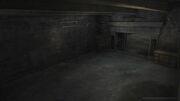 Development concept for the hidden room
 -
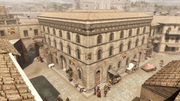 The Palazzo and its surrounding streets
 -
 The Palazzo under guard
 -
 The Palazzo in Lineage


Appearances[edit | edit source]
- Assassin's Creed: Lineage (first appearance)
- Assassin's Creed II
- Assassin's Creed: Brotherhood novel (mentioned only)
References[edit | edit source]
- ↑ Assassin's Creed II – Database: Palazzo Auditore
- ↑ 2.0 2.1 Assassin's Creed II
- ↑ Assassin's Creed: Lineage
- ↑ Assassin's Creed II – Bonfire of the Vanities
- ↑ Assassin's Creed: Brotherhood novel – [citation needed]