

Harbor of Theodosius: Difference between revisions
imported>CoffeeRocks m moved Harbour of Theodosius to Portus Theodosiacus: ... |
imported>Zone of Endless m removing newline between Era and WP-REAL |
||
| (27 intermediate revisions by 13 users not shown) | |||
| Line 1: | Line 1: | ||
{{Era| | {{Era|Locations}}{{WP-REAL|Harbour of Eleutherios}} | ||
{{ | {{Landmark Infobox | ||
|name = Harbor of Theodosius | |||
{{ | |image = Arsenal Harbor of Theodosius Database image.png | ||
|location = [[Constantinople]] | |||
| | |dateconstructed = | ||
| | |functions = Arsenal<br>Harbor}} | ||
| | The '''Harbor of Theodosius''', also simply called the '''Arsenal''', was the largest of the ports found in [[Constantinople]], the capital of the [[Byzantine Empire|Byzantine]] and [[Ottoman Empire|Ottoman]] Empires. The harbor was located on the south side of the peninsula where the city was built, facing towards the {{Wiki|Sea of Marmara}}. | ||
| | |||
| | |||
| | |||
}} | |||
In the 16th century, the port was used for the building of [[ships]], as a meeting place for [[Manuel Palaiologos]] and [[Tarik Barleti]], and later as a military stronghold by the [[Ottoman Empire|Ottoman]] Prince [[Ahmet]]. | |||
==History== | ==History== | ||
===Origin=== | |||
The port, originally called the Harbor of Eleutherios, was augmented by Emperor [[Theodosius I]] in the 4th century, earning its current name. It would go on to become a major venue for trade of agricultural goods, as well as a military outpost.<ref name="Database">''[[Assassin's Creed: Revelations]]'' – [[Database: Harbor of Theodosius]]</ref> | |||
== | ===Civilian riot=== | ||
*'' | [[File:Arsenal Infiltration 1.png|thumb|250px|left|Citizens and Janissaries fighting within the arsenal.]] | ||
In 1511, the [[Assassins|Assassin]] [[Ezio Auditore da Firenze]] [[Riot at the Harbor of Theodosius|incited a riot]] within the harbor, by using [[heralds]] to speak to nearby [[civilians]] about the abuse of power by the [[Janissaries]]. The rioters banded together in forcing open the Arsenal gates, setting fires and attacking the Janissaries, while Ezio used the confusion within as an opportunity to seek out a member of the [[Templars|Templar Order]], Manuel Palaiologos.<ref name="Revelations">''Assassin's Creed: Revelations''</ref> | |||
Ezio tailed Manuel and his fellow Templar [[Shahkulu]] to a small warehouse, where a shipment of [[firearms]] had been delivered. After observing a brief meeting between Shahkulu, Manuel and Tarik Barleti, Ezio fled the harbor in an attempt to alert his fellow Assassins. Upon arriving back at the Arsenal gates, Ezio found nearly all of the rioters slaughtered, and left the harbor.<ref name="Revelations" /> | |||
===Assassin attack=== | |||
[[File:Discovery 4.png|thumb|250px|Ezio leading the attack against the Byzantines]] | |||
The following year, in 1512, after discovering the murder of the [[Assassin leader]] [[Yusuf Tazim]], as well as the kidnap of [[Sofia Sartor]], Ezio led the [[Ottoman Brotherhood of Assassins|Ottoman Assassins]] in a large scale attack on the harbor, in which Prince Ahmet and his Byzantine forces were stationed.<ref name="Revelations" /> | |||
There, the Assassins engaged with a large number of soldiers, and eventually cornered their commander. However, Ezio was forced to allow the Templar to escape, as Sofia was still being held hostage.<ref name="Revelations" /> | |||
===Later years=== | |||
During later Ottoman rule in the 1500s, a large amount of silting – or the building up of sediments along the bank – forced the port to be closed, and eventually built over. Similar activity continued until, in the 17th century, the harbor had all but disappeared.<ref name="Database" /> | |||
In the 21st century, the site was excavated, and workers discovered the remains of dozens of ancient Byzantine galleys deep within the soil.<ref name="Database" /> | |||
==Gallery== | |||
<gallery captionalign="center" position="center" spacing="small" widths="180"> | |||
ACR_Harbour_of_Theodosius_Art.jpg|Concept art of the harbor | |||
Dechambo Arsenal Docks Concept.JPG|Concept art of the harbor | |||
87982 ACR SP CA 09 Constantinople Arsenal.jpg|Concept art of the harbor | |||
</gallery> | |||
==Appearances== | |||
*''[[Assassin's Creed: Revelations]]'' | |||
==References== | |||
{{Reflist}} | |||
[[Category:Ports]] | |||
[[Category:Landmarks in Constantinople]] | |||
Latest revision as of 22:12, 14 October 2021
The Harbor of Theodosius, also simply called the Arsenal, was the largest of the ports found in Constantinople, the capital of the Byzantine and Ottoman Empires. The harbor was located on the south side of the peninsula where the city was built, facing towards the Sea of Marmara.
In the 16th century, the port was used for the building of ships, as a meeting place for Manuel Palaiologos and Tarik Barleti, and later as a military stronghold by the Ottoman Prince Ahmet.
History[edit | edit source]
Origin[edit | edit source]
The port, originally called the Harbor of Eleutherios, was augmented by Emperor Theodosius I in the 4th century, earning its current name. It would go on to become a major venue for trade of agricultural goods, as well as a military outpost.[1]
Civilian riot[edit | edit source]

In 1511, the Assassin Ezio Auditore da Firenze incited a riot within the harbor, by using heralds to speak to nearby civilians about the abuse of power by the Janissaries. The rioters banded together in forcing open the Arsenal gates, setting fires and attacking the Janissaries, while Ezio used the confusion within as an opportunity to seek out a member of the Templar Order, Manuel Palaiologos.[2]
Ezio tailed Manuel and his fellow Templar Shahkulu to a small warehouse, where a shipment of firearms had been delivered. After observing a brief meeting between Shahkulu, Manuel and Tarik Barleti, Ezio fled the harbor in an attempt to alert his fellow Assassins. Upon arriving back at the Arsenal gates, Ezio found nearly all of the rioters slaughtered, and left the harbor.[2]
Assassin attack[edit | edit source]

The following year, in 1512, after discovering the murder of the Assassin leader Yusuf Tazim, as well as the kidnap of Sofia Sartor, Ezio led the Ottoman Assassins in a large scale attack on the harbor, in which Prince Ahmet and his Byzantine forces were stationed.[2]
There, the Assassins engaged with a large number of soldiers, and eventually cornered their commander. However, Ezio was forced to allow the Templar to escape, as Sofia was still being held hostage.[2]
Later years[edit | edit source]
During later Ottoman rule in the 1500s, a large amount of silting – or the building up of sediments along the bank – forced the port to be closed, and eventually built over. Similar activity continued until, in the 17th century, the harbor had all but disappeared.[1]
In the 21st century, the site was excavated, and workers discovered the remains of dozens of ancient Byzantine galleys deep within the soil.[1]
Gallery[edit | edit source]
-
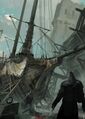 Concept art of the harbor
 -
 Concept art of the harbor
 -
 Concept art of the harbor


Appearances[edit | edit source]
References[edit | edit source]
- ↑ 1.0 1.1 1.2 Assassin's Creed: Revelations – Database: Harbor of Theodosius
- ↑ 2.0 2.1 2.2 2.3 Assassin's Creed: Revelations