Welcome to Assassin's Creed Wiki! Log in and join the community.


Donkey: Difference between revisions
Jump to navigation
Jump to search
imported>Lady Kyashira mNo edit summary |
|||
| (One intermediate revision by one other user not shown) | |||
| Line 23: | Line 23: | ||
==Appearances== | ==Appearances== | ||
*''[[Assassin's Creed IV: Black Flag]]'' {{1stm}} {{Mdat}} | |||
*''[[Assassin's Creed: Origins]]'' {{1st}} | *''[[Assassin's Creed: Origins]]'' {{1st}} | ||
*''[[Assassin's Creed: Odyssey]]'' | *''[[Assassin's Creed: Odyssey]]'' | ||
| Line 29: | Line 30: | ||
*''[[Assassin's Creed: The Engine of History – The Resurrection Plot]]'' | *''[[Assassin's Creed: The Engine of History – The Resurrection Plot]]'' | ||
*''[[Assassin's Creed: Mirage]]'' | *''[[Assassin's Creed: Mirage]]'' | ||
**''[[Valley of Memory]]'' | |||
==References== | ==References== | ||
Latest revision as of 07:43, 8 July 2026

|
Patience, brothers. Soon we will reveal the secrets of this painting. This article has been identified as being out of date. Please update the article to reflect recent releases and then remove this template once done. |

Donkeys are a domesticated species of equine found worldwide, commonly used as beasts of burden.
History[edit | edit source]
5th century BCE[edit | edit source]
During the Peloponnesian War, donkeys were a common sight everywhere in Greece. At that time, their hooves were valued at 3 drachmae apiece.[1]
1st century BCE[edit | edit source]
Around 49 BCE, Egyptians kept donkeys, and they were often encountered in Alexandria and surrounding villages, like Kanopos.[2]
Behind the scenes[edit | edit source]
The mural depicting a donkey ridden by the Greek god Hephaistos in Assassin's Creed: Odyssey is based on a vase painting from the 5th century BCE.
Gallery[edit | edit source]
-
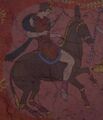 A 5th century BCE mural of Hephaistos, holding tongs and riding a donkey
 -
 A donkey in Baghdad
 -


Appearances[edit | edit source]
- Assassin's Creed IV: Black Flag (first mentioned) (mentioned in Database entry only)
- Assassin's Creed: Origins (first appearance)
- Assassin's Creed: Odyssey
- Assassin's Creed: Valhalla
- Assassin's Creed: The Engine of History – The Resurrection Plot
- Assassin's Creed: Mirage